
Most conversations about real estate focus on the property: the location, the units, the renovation, the rent. But the factor that most often decides whether an investment survives a difficult market is not the building — it is the debt behind it. How a sponsor uses leverage is one of the clearest signals of how it manages risk.
VisionWise Capital (VWC) treats leverage conservatively on purpose. The firm keeps loan-to-value under 50% on all properties, so equity, not debt, carries the majority of every investment. This article explains what that discipline means, why it matters, and how accredited investors can weigh it when evaluating any private real estate opportunity.
Who This Is For
This overview is written for accredited investors, Registered Investment Advisors, family offices, and successful professionals evaluating private real estate. It is educational only. It is not an offer to sell securities or a solicitation of an offer to buy securities, and it is not investment, legal, or tax advice. VisionWise Capital offers a private placement to accredited investors only.
What Is Leverage, and What Does Loan-to-Value Mean?
Leverage is simply the use of borrowed money to help fund an investment. In real estate it is measured by loan-to-value (LTV): the size of the loan divided by the value of the property. A property bought with a loan equal to 70% of its value has a 70% LTV; a property financed with a loan equal to 45% of its value has a 45% LTV.
Higher leverage can magnify results in both directions. It can amplify returns when values and rents rise, and it can amplify losses when they fall or when financing becomes harder to renew. Lower leverage does the opposite: it moderates the upside from debt while providing a larger cushion if conditions turn. Understanding where a sponsor sits on that spectrum is essential due diligence.
Why Debt Structure Is the Greatest Risk
VisionWise Capital’s stated view is direct: the greatest risk in real estate investing is the structure of the debt. Many real estate problems that look like property problems are really financing problems — a loan that matures at the wrong time, a rate that resets higher, or a lender that will not refinance when values have dipped.
A property with modest, well-structured debt has room to weather a soft patch. A property that is heavily leveraged has far less margin for error: a small drop in value or a jump in financing costs can erase the equity quickly. That is why conservative leverage sits at the center of VWC’s approach rather than at the edges.
How VisionWise Capital Uses Conservative Leverage
VWC keeps the loan-to-value ratio under 50% on all properties as a principal-protection discipline. In practice, that means each property is acquired with more equity than debt, so the investment is less dependent on financing markets and better positioned to hold through a cycle. Conservative leverage is a risk-management approach — it is not a guarantee against loss.
VisionWise Capital is a multifamily real estate investment firm that gives accredited investors direct equity exposure to Southern California multifamily properties. Keeping leverage low is one of the ways the firm pursues its mission of being a thoughtful steward of its investors’ capital.
What “Under 50% LTV” Means for the Equity Cushion
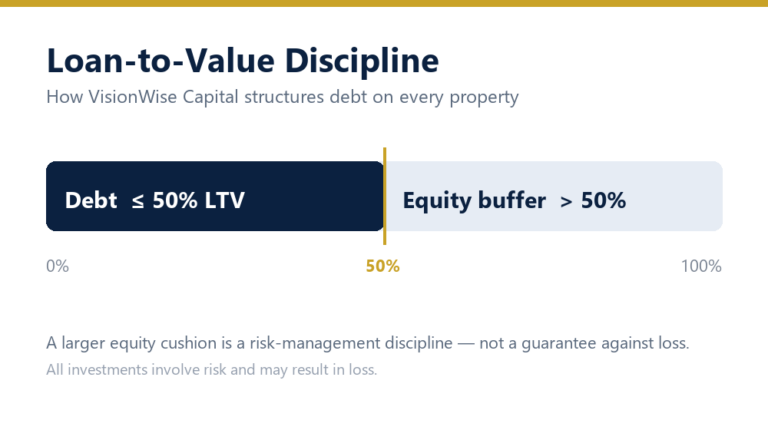
When debt is kept under half of a property’s value, the remaining equity acts as a buffer. If values decline, that cushion absorbs the impact before the loan is at risk, and it gives the operator more flexibility to make decisions on its own timeline rather than a lender’s. A larger equity cushion is a risk-management discipline, not a promise of any particular result.
Conservative Leverage Through Market Cycles
Markets move in cycles, and financing conditions move with them. When interest rates rise or credit tightens, highly leveraged owners can be forced to sell or refinance at exactly the wrong moment. A lower-leverage position is designed to reduce that pressure, preserving options when others have few.
None of this removes risk. Real estate still carries market, operating, liquidity, and execution risk regardless of how it is financed. The goal of conservative leverage is not to eliminate risk but to manage one of its largest and most controllable sources. All investments involve risk and may result in loss.
How Leverage Fits VWC’s Overall Process
Conservative leverage is one part of a repeatable process VisionWise Capital describes as BUY, Restore, MANAGE, REINVEST. VWC targets “Old, Tired and Occupied” multifamily properties, typically 5 to 50 units in Southern California, acquires them at conservative loan-to-value, renovates them to modern standards, manages them for cash flow, and reinvests proceeds. Low leverage supports every stage by keeping the balance sheet resilient.
Alignment matters too. VisionWise Capital was founded by Sanford Coggins, a former Registered Investment Advisor, and the firm invests its own capital — “skin in the game” — on every project. An operator that shares the downside has a direct incentive to keep leverage disciplined.
What This Means for Investors
For accredited investors and their advisors, a sponsor’s leverage policy is a fast, revealing question. Ask what the maximum LTV is, whether it applies to every property, how debt is structured, and what would happen in a downturn. A sponsor that can answer clearly and consistently is easier to evaluate.
VWC’s offerings are available to accredited investors only. As with any private investment, review the offering documents and discuss suitability, structure, and tax treatment with your own legal and tax advisors before making a decision.
Questions to Ask Before Proceeding
- What is the maximum loan-to-value, and does it apply to every property?
- How is the debt structured, and when do loans mature?
- How would rising rates or a value decline affect this investment?
- What equity cushion remains if values fall?
- Does the sponsor invest its own capital alongside investors?
- Am I an accredited investor, and does this fit my broader financial plan?
- Have my legal and tax advisors reviewed the offering documents?
FAQs
What does conservative leverage mean in real estate?
Conservative leverage means using a relatively low amount of debt compared with a property’s value. VisionWise Capital keeps loan-to-value under 50% on all properties, so equity — not debt — makes up the majority of each investment. It is a risk-management discipline, not a guarantee against loss.
What is loan-to-value (LTV), and why does it matter?
Loan-to-value is the size of the loan divided by the value of the property. A lower LTV means a larger equity cushion and less reliance on financing. Because the structure of the debt is one of the greatest risks in real estate, LTV is one of the first things an accredited investor should ask a sponsor about.
Why does VisionWise Capital keep LTV under 50%?
VWC treats debt structure as the greatest risk in real estate investing, so it caps loan-to-value under 50% on all properties to preserve a larger equity buffer through market cycles. This is a principal-protection emphasis, not a promise of any particular outcome.
Does conservative leverage remove risk?
No. Lower leverage can reduce refinancing pressure and provide a buffer in a downturn, but it does not remove market, operating, liquidity, or execution risk. All investments involve risk and may result in loss.
Who is VisionWise Capital’s approach designed for?
VWC offers a private placement available to accredited investors only, including high-net-worth investors, Registered Investment Advisors, and family offices seeking direct equity exposure to Southern California multifamily real estate.
How does leverage fit into VWC’s overall process?
Conservative leverage is one part of VWC’s BUY, Restore, MANAGE, REINVEST process. VWC acquires under-managed Southern California multifamily properties at conservative loan-to-value, renovates and manages them for cash flow, and reinvests proceeds — with the founder investing alongside investors.
Important Information
Past performance is no guarantee of future results. All investments involve risk and may result in loss. This material is for informational purposes only and does not constitute an offer to sell securities or a solicitation of an offer to buy securities. Private offerings are available to accredited investors only.
Accredited investors who want to understand how conservative leverage fits a private multifamily strategy can schedule a consultation with VisionWise Capital to request the fund overview.